
Innovation 101: Part 3
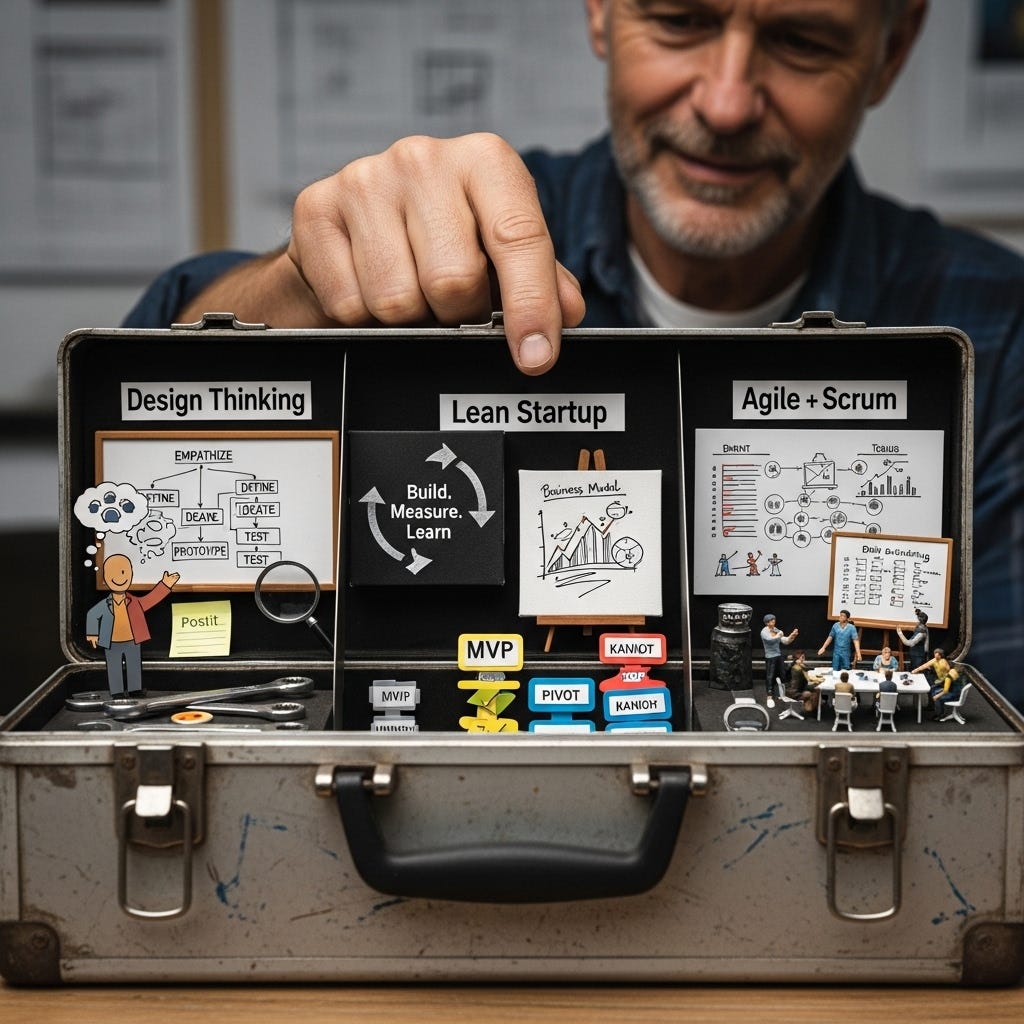
The Innovator's Toolkit

Hello again! If you’ve survived the digital buzzwords (Lesson 1) and embraced the chaos of culture change (Lesson 2), you’re ready for the most powerful step: structure.
Here’s the thing: great ideas are cheap. Everyone has that flash of brilliance for a world-changing app or a service that simplifies life. But if you try to build it without a map, you will burn time, resources, and morale. Innovation is not a random act of genius; it’s a disciplined, repeatable process.
We’re going to look at three methodologies that successful organisations, from nimble start-ups to the big corporates, use to navigate the path from vague concept to validated, market-ready product. Think of this as your integrated, high-powered toolkit. I’ve worked across quite a few different industries, and led a wide range of Innovation Projects , and I’ve seen many companies that do some of these well, but it’s the ones that bring them all together that really fly. One thing I should say: I’ve given you specific frameworks here, but not all of the elite innovators I’ve worked with deploy all of these. But they do all deploy the three approaches in one form or another. However, this is a 101, so I’m assuming that you’re new to this, and these frameworks give you a great starting point.
1. Design Thinking: The Empathy Engine
If you want to build a better door, don’t just start designing a handle. Start by observing how people try to open doors when their hands are full.
Design Thinking is your “Empathy Engine.” It’s the human-centred process that ensures you are solving the right problem for the right people. Before you spend a penny on development, this framework forces you to challenge every assumption you hold about your user. You’d be shocked at how many times I’ve heard the phrase “We know what our customers want”, only to engage with customers and discover that what the business thought was the bug problem, was a minor irritation and something completely left-field was what would really make a difference.
The process is structured, but delightfully flexible:
Empathize: This is where the magic starts, and you get to be an innovation James Bond. You conduct interviews, observe your customers in their natural habitat, and actively listen to understand their deepest frustrations and needs not just what they say they want, but what they do.
Define: You take all that rich, sometimes messy, data and articulate a precise problem statement. You frame the challenge clearly and concisely. Most importantly, you do it from the perspective of the customer
Ideate: Time to brainstorm! Forget judgment; you need a high volume of ideas, the crazy, the brilliant, and the utterly bizarre, to ensure you haven’t missed a non-obvious solution. We call the out-there ideas dark horses, and sometimes it’s where the genuinely innovative gems lie.
Prototype: Quickly create a basic, tangible representation of your best ideas. This can be a sketch, a cardboard model, or a simple digital mock-up. It just needs to be testable. My little tip: go rough-and-ready. People will be much more willing to criticise some scrappy outlines of mobile app screens that you’ve scribbled on post-it notes (other sticky notes are available, but in my experience have a tendency to fall off), than they are a slick, polished mock-up that you’ve clearly spent time and money on. They won’t want to hurt your feelings, but the feedback is critical.
Test: You take the prototype back to your users. Does it work? Is it intuitive? Is it what they need? This feedback loop is the lifeblood of the process, preventing you from sinking major investment into a product that no one will use. My favourite question here is “Is this what you meant?” validate whether you have really captured the essence of their problem, and have a promising start to solving it.
The Core Principle: Design Thinking is the foundation. It prevents the colossal and expensive mistake of launching a beautiful solution to a problem that doesn’t actually exist.
2. The Lean Startup: The Scientific Method for Business
You have an idea that passed the empathy test. Great. But how do you prove it will work as a business without risking your entire budget?
Enter The Lean Startup methodology (Don’t get hung up on the word Startup, it’s an approach that works regardless of how big your organisation is). This framework is a scientific approach for creating and managing startups, designed to get products to market faster and, crucially, with minimal risk. It is fundamentally about eliminating waste by validating your riskiest assumptions first.
It revolves entirely around the rapid Build-Measure-Learn cycle:
Build (the MVP): You create the Minimal Viable Product (MVP). This is not a rough version of your final product; it’s the smallest thing you can build to start the learning process. It has just enough core features to be usable by early customers.
Measure: You release the MVP and relentlessly collect data (analytics, metrics, feedback). You are measuring adoption, engagement, and whether users are solving the problem you designed the product for.
Learn (Pivot or Persevere): Based on the data, you make a crucial strategic decision: Do you Pivot (change your strategy because your assumptions were wrong) or Persevere (continue refining the existing product because the data supports your path)?
The Core Principle: Lean Startup turns your idea into a series of testable hypotheses. You use real-world customer data to make every decision, ensuring that every subsequent step is more informed and less wasteful.
3. Agile and Scrum: The Execution Machine
So you’ve found the right problem (Design Thinking) and you’ve validated the solution (Lean Startup). Now, how do you manage the actual day-to-day development in a world that moves at lightning speed?
This is the domain of Agile and Scrum.
Unlike the old “Waterfall” method, where development was a long, linear, and rigid process, Agile is all about speed, flexibility, and incremental delivery. It’s designed to ensure your team can adapt to new information instantly a necessary skill when the market or customer needs change weekly. I like to think of it as getting small packets of value into the hands of customers as quickly as possible so that they get more value, and we can learn.
Key characteristics of an Agile environment:
Sprints: Work is broken down into short, time-boxed iterations, typically one to four weeks long. At the end of every sprint, the team delivers a working, functional piece of the product.
Self-Organized Teams: Teams are cross-functional (they have all the skills they need internally) and empowered to make decisions about how they complete the work.
Scrum: Daily stand-up meetings ensure communication is constant and obstacles are addressed immediately. This frequent, low-friction communication prevents issues from spiralling out of control.
The Core Principle: Agile is the execution framework that ensures your innovation scales successfully. It treats change not as an error, but as an expected part of the journey, allowing you to incorporate customer feedback continually. And that’s the important part, don’t just look to involve your customers at the beginning. They’re almost an extra member of your product team, co-create with them for the life of the product.
The Synthesis: The End-to-End Innovation Loop
No major organisation relies on just one of these. The true power lies in the synthesis.
These three frameworks aren’t competitors; they are designed to work together in a continuous loop:
Design Thinking defines the RIGHT PROBLEM to solve.
Lean Startup validates the RIGHT SOLUTION for that problem.
Agile provides the flexible structure for BUILDING AND SCALING the validated solution.
In the UK, bodies like the Government Digital Service (GDS) and their Digital, Data and Technology (DDaT) Capability Framework use these systematic approaches to execute complex public sector projects. They understand that if you want to deliver value reliably, you need a structured, methodological guiding path.
By mastering this complete toolkit, you gain a common language and a clear roadmap for your entire innovation team. You transform the unpredictable chaos of invention into a measurable, repeatable business function.
So, we’ve looked at what innovation really is, we’ve looked at why culture is the primary driver for success, and we’ve explored the tools that make sure you commoditise innovation within your organisation. In the final installment we’ll look at real-world success and failure to help you understand how to lead successful innovation, and avoid the common bannana skins.